


This is my ongoing scifi / fantasy / crime fiction serial. New chapter every week.
The Triverse is
Mid-Earth, an alternate 1980s London
Max-Earth, a vision of the 26th century
Palinor, where magic is real
Previously: On Palinor, the rogue AI Probably Better has been defeated by a coalition of unusual allies. Back on Mid-Earth, in London, former detective Yannick Clarke has been leading the march of the resistance across the city towards Westminster…

London. Mid-Earth.
1980. July.
The unknown was part of the job. Clarke had made peace with that decades back, on his first case as a junior officer: stepping into an unfamiliar room, inserting himself into the lives of others, learning their secrets and fears, untangling past events, building a timeline from scattered scraps of information. Sometimes they found the perp, sometimes not. It was the job; some things became known, others remained hidden.
Dealing with victims and criminals had a distance to it, because it was about other people. Ever since Callihan had died, that separation had been turned on its head. Clarke had been at the centre of things for far longer than he was comfortable. He was trapped at a surprise birthday party, all the attention on him - and on Styles, and Chakraborty, and Kaminski. Holland had been in deeper than any of them, and he’d managed to get out. Clarke wasn’t sure that was going to be an option for the rest of them.
Trying to shut the thoughts from his mind was impossible. The Joint Council tower had come down, quite possibly with the others still inside. The south side of the river was a disaster zone, the air above London thicker and more toxic than usual from the fumes,. It’s where he should have been, providing assistance, yet here he was standing at the gates of power. There were rumours that a megaship had been sighted transiting the portals earlier in the day, so god knows what that meant for Styles and the others over on Palinor. It wasn’t inconceivable that he was the last of them still standing.
In which case, he’d better concentrate and get it done.
The dual clocktowers of the palace stood proudly over the river, their faces illuminated in the gathering gloom of the evening. It had taken Clarke most of his adult life to realise that Max-Earth’s equivalent to the Palace of Westminster had only a single tower; the display of supposed superiority was the perfect encapsulation of the Kingdom of Great Britain’s attitude since the Joining. Two centuries of posturing and playing catch-up, always envious of what had been achieved in the future visions of Max-Earth. Those clockfaces, malleable and patriotic, representative of so much. Clarke had once looked upon them with immense pride, as a young man on the beat in London. In later years they’d been a symbol of retreat and stagnation. During his exile on the other side of the portal, he couldn’t bear to see a photograph or postcard baering their iconic designs, co-opted as they had been by Prime Minsiter Maxwell and his neo-fascist goons.
Hitler had not existed on Mid-Earth. Mussolini had never come to power in Italy. The two global conflagrations of Max-Earth’s twentieth century had never happened on Mid-Earth, yet that had not stopped people following in their footsteps. The blueprint was always the same. Nigel Maxwell was a pale imitation of his alternate history idols, but that hadn’t stopped him from being dangerous. The goalposts shifted, the scapegoats had different names, but the playbook remained.
Soon, Maxwell would share another recurring trait with his adopted heroes: utter defeat.
“Once we’re in,” Clarke said, projecting his voice as best he could to the gathered crowd outside the palace entrance, “exercise restraint. We need minimal injuries. Do not damage the building or any of the offices inside. This needs to be clean.”
Vahko nodded and relayed the message, their booming roar spreading considerably further. Clarke could hear the message being passed along, from the gates all the way back down Whitehall and the embankment. The uprising had pushed past the neutered defences, the crew in the Joint Council tower having completed their task, at a cost he still didn’t know.
The koth, a former ambassador, a former inhabitant of the non-human ghetto, and current resistance leader, looked to Clarke. “On your signal, detective.”
He nodded. There were journalists somewhere in the crowd, which meant getting the story straight. “Open the doors.”
Two of Vahko’s lieutenants braced themselves, then heaved their shoulders against the entrance to the palace. The doors shook, then there was a splintering sound and they swung open. Westminster Hall beckoned, its enormity making even the gathered koth seem small. There was little resistance as they passed through into the corridors, heading in the direction of the two chambers. They split up, Vahko taking a contingent to the Lords Chamber while Clarke continued to the Commons. He’d been to Westminster before, as a uniformed officer, but had never ventured beyond the great hall. He had never imagined returning as a revolutionary. The notion was absurd, was a joke. Even backed by a growing crowd of supporters from across the triverse, Clarke couldn’t help but question himself: he had never been a radical thinker, had never thought much about power or politics, until it had been forced upon him. And following a certain gentle prodding and poking from a couple of young, idealistic and naive partners. Callihan had warmed up his mind, and Styles had taken him the rest of the way. Maybe not so naive, after all.
The doors to the Commons Chamber were barricaded, with half a dozen armed men wearing the insignia of the Earth First special branch. Their not-so-secret police offshoot, that had been home to the thugs and corrupt officials drawn to power over the previous half decade. The Met had always had its problems, and Earth First had embraced all of them.
Each of them dropped their guns at the first sight of Clarke and his entourage. Upon closer inspection, as the Earth First loyalists were secured, it became apparent that they hadn’t been defending the chamber but had instead been attempting to break into it. The thick, wooden door was covered with scratches and dents from axe and crowbar impacts.
“This is former police detective Yannick Clarke,” he announced, hoping his voice would carry through the door. He’d practised this moment. “I am here with a contingent of supporters to liberate Westminster and return power to the electorate. I have the backing of Commissioner Matthew Graves, DCI Stephen Walpole and DI Robert Ford. With me are former ambassador to Palinor, Vahko, and many others. What is your response?”
There was silence, then after several seconds the sound of furniture being moved from the other side of the doors. One of them opened a crack, revealing an unexpectedly familiar face.
“DI Morgan,” Clarke said, his surprise clearly evident on his face.
Lois Morgan smiled at him through the gap. “Clarke. Ford told me you were up to something. We’ve been protecting the MPs in the chamber. What’s the situation?”
“The palace is secure, as far as we know. The streets outside, as well. There are thousands of us out here, guv.”
The doors opened a little wider and she gestured for him to enter. Clarke moved inside cautiously, accompanied by a small team of koth, humans and aen’fa. The MPs were all huddled at the far end of the chamber, near the despatch boxes. Some of them were on their feet and stepped forward. To one side, seated on the benches and flanked by armed police officers, were ministers that Clarke recognised as Earth First representatives.
“They tried to round up all the other party MPs,” Morgan said. “I don’t like to think what they had in mind for them, but we got here first. I’m not sure how long we could have holed up in here if you hadn’t arrived.”
“It’s over, then.”
She threw him a cynical glance. “The PM is in the wind. Maxwell hasn’t been seen since the koth broke out of the east end camp.”
“Shit.” He still had no idea what was happening on Palinor; success here didn’t necessarily mean victory on the other side of the portal. Nisha, Zoltan and the others were still unaccounted for.
“We’ll find him,” Morgan said. “We’ll find all of them. You should see the records they’d been keeping - I don’t think they ever expected to be out of power, so the paper trail is likely to go right to the top.” She sighed. “Not exactly what we joined the force for, is it?”
Clarke felt more tired than he’d ever been in his life. His heart was still hammering, the adrenaline having nowhere to go. “I should have retired years ago.” He pinched the bridge of his nose between thumb and forefinger and chuckled. “I could have been sat in the pub this whole time.”
She clapped him on the shoulder. “But then where would we be?”

Meanwhile.
Thanks for reading! We draw ever closer to Triverse’s ending.
Welcome to 2026, and happy new year! I don’t know about you, but 2025 felt like a real crammer of a year: far more stuff happened than usual — or, at least that was my perception. Personal stuff, creative activity, real world politics and news; all of it piled on top of each other, and was run through a hazy filter of me trying to wrangle the Triverse finale into shape.
It’s the closest I’ve come to burnout, I think.
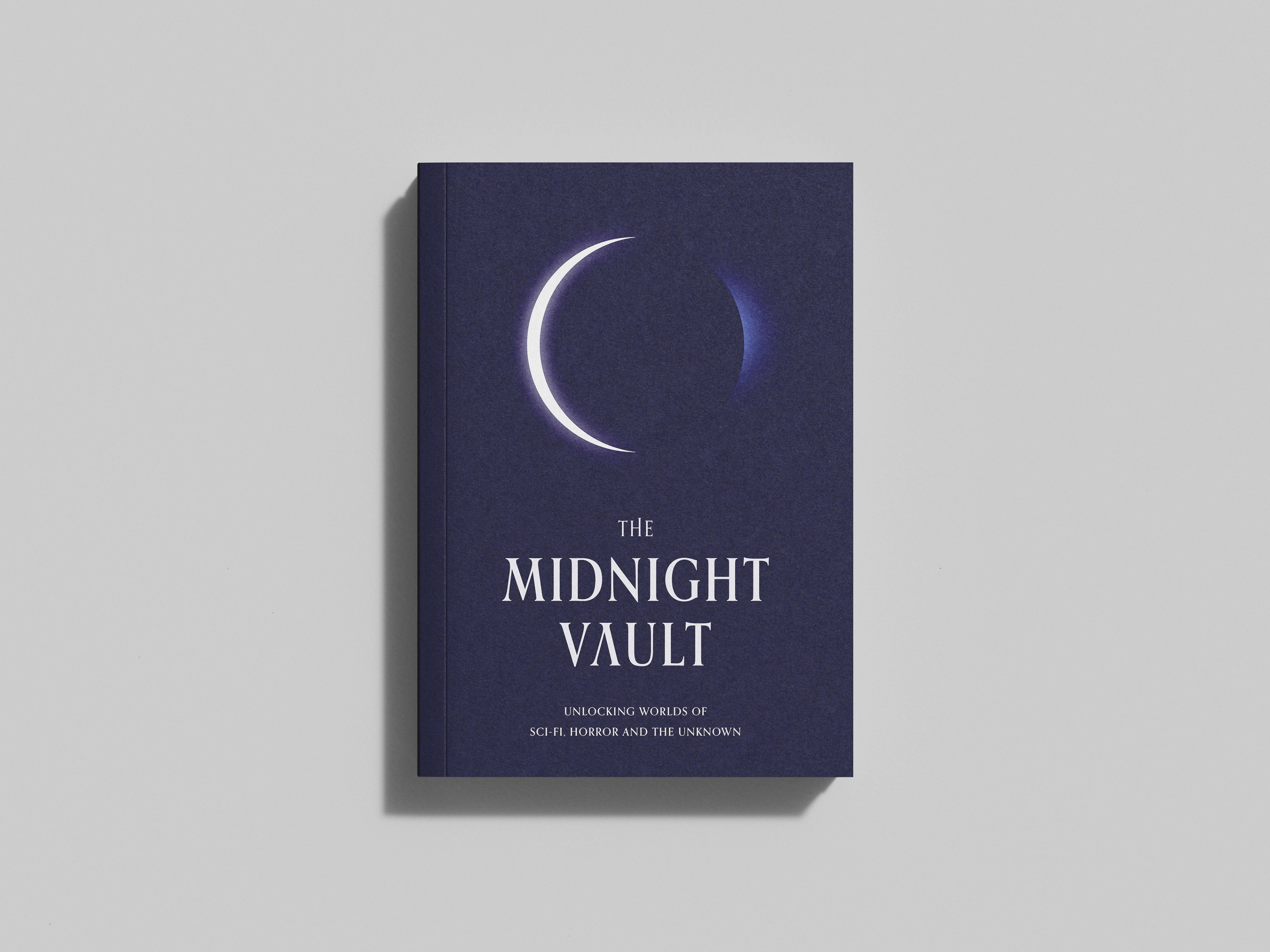
Being heads-down in Triverse also meant being somewhat disconnected from the indie fiction scene, which resulted in The Midnight Vault completely passing me by at the time of its original conception and release. You can find out more about it here:

So many great authors, many of whom I already read and follow. Yet somehow I hadn’t quite twigged that this event took place: a failure on my part, and perhaps on the part of The Algorithm. Anyway, I’m now course-correcting and have picked up the beautiful1 paperback anthology. Aside from being packed full of stories, it’s also a who’s-who of spec fic writers on Substack.
You can grab the book from the usual places — do check it out if you like provocative, thoughtful scifi and horror in the style of The Twilight Zone.
Also this week, I stumbled upon this wonderful piece by Celine Nguyen:

Reading Celine’s article was like discovering a much better researched and composed version of my jumbled ramblings from the last four years. This paragraph in particular:
If you’re exclusively interested in the output of writing, then it makes sense to chastise people who write badly—because the output seems to be inferior to what others are capable of producing. But if you think of writing as a process, then you understand that writing badly is the only way to begin writing well, and the output isn’t the piece—it’s the mind that labored earnestly to produce the piece.
Needless to say, I will be rummaging through Celine’s back catalogue. Thanks to Naomi Alderman for pointing me in Celine’s direction in the first place (pro tip: following Naomi is an excellent way to regularly discover Very Interesting Things).
Author notes
In the end, the regime of Earth First ends with a whimper, rather than a bang.
I’m always fascinated by the slowly-slowly-suddenly collapse of authoritarian regimes. They appear to be invulnerable, inevitable, immortal, right up until the moment they cease to exist.
There’s an inverse relationship at play: regimes that appear the strongest, the fiercest, the most deadly, are the ones with the loosest foundations, and the least loyalty and commitment: fear drives everything, and the moment that the shackles of fear break, it all comes crashing down. To create, impose and maintain such a system requires an enormous exertion of energies. The authoritarian engine can splutter and choke if the fuel supply is interrupted for even a moment.
On the flipside, the societies which appear to be weak, to be fragile, are the ones most beloved by the people living within them. Those institutions are fought for, and persist as a hard to quantify ideas. Even when all hope seems lost, it takes only the tiniest ember to relight the fire.
That’s what the crumbling of Earth First is depicting: when it came to it, Prime Minister Maxwell and his lot had the illusion of strength, but it was built on lies and fear. Clarke, Vahko and the others have broken the spell.
Away from politics and history, it also made sense to have the Mid-Earth resolution be quieter: the epic fantasy action of the Palinor chapters has been exciting, thrilling, surprising, but that kind of relentless tension can also become exhausting. Too much of a good thing will always become boring. Having another high stakes, action-oriented finale on Mid-Earth would simply have been a repeat. Better, instead, to switch up the pacing and have it end with a conversation.
I’d originally intended for ‘Parliament’ to take pace between the ‘Magic’ and ‘Absolute Power’ stories. It would have served as a break in the Palinor action, adding some “what happens now??” tension following Justin’s arrival through the portal. The problem is that it would have been an annoying shift: that change of pacing would have been distracting — inevitably, many readers would simply want to get back to Palinor and Lola. It’s the same problem movies have when inter-cutting a three-pronged finale: if any of those strands are inferior to the others, especially if the audience cares less about some characters than others, it can unravel the whole thing.
Hence, shifting ‘Parliament’ to after ‘Absolute Power’, where it fits much more neatly. There is still unresolved tension regardless, as we don’t yet know the fates of Justin, Lola, Nisha, Zoltan and everyone else.
If Triverse was a TV show, there would be two episodes left. Three, if you count a fun bonus chapter I have in mind (it’s been a while since I had time to throw in a bonus).
Then, we’ll be done.
Meanwhile, on Mondays I’m thinking of doing a series of posts about the inspirations behind Tales from the Triverse. I’ve talked about some of them before, but it’d be good to dive into each of them in some more detail.
Until then — have a good weekend.
Designed by Shane Bzdok, who details the design process here in exactly the kind of behind-the-scenes post that I adore:

Thanks for featuring my article, "From the Zone to the Vault," Simon. 🙏 And hopefully, we'll see in the mix come November of this year!
I suspect what happened at the Joint Tower made the march on Westminster easier. Let's face it, while there had been rioting, catastrophic collapse of a chunk of downtown London is going to help stop your riot. Police and emergency services MUST respond to the collapse, while a certain proportion of rioters -- decent people at heart -- will also divert to help.
You haven't described it (perhaps you should have? Consider this paranthetical a critique/question.), but PB moving at speed through the portal stations, the collapse of Joint Council Tower, damage to surrounding buildings and streets, not to mention inevitable fires and/or explosions (ruptured gas mains/downed electrical grid), flooding (damage to water pipes and sewers), and London is full of smoke, ash, dirt, asbestos (nah, Max-Earth would have stopped asbestos), etc in the air. The smells of smoke, ozone, (asbestos 😏), and, yes, blood ooze through the city.
Oh, right, then TWO Quantum AI Megaships burst back through the portal and fell on more buildings. Last week. That's action! That's also more drain on emergency services and more civilian distraction/Good Samaritan action.
(Now, here's a good question... Where, exactly, did the Palinor/Max-Earth panel open? Honestly, it's pretty damn lucky Just Enough was more or less immediately able to pop through from an open space. We'll have a longer chat about this on WhatsApp and you can tell me if I've found a legit nit or not...)
Thus, part of the reason this is a lower-key part of the climax is the exciting action sequence already happened. Riots, and the big booms downtown.
Nope, these are the shell-shocked survivors -- the few who held focus on the bigger picture of politics and justice in the face of immediate short-to-mid-term disaster -- tired, dirty, dazed, and holding their shit together with their last reserves.
Yannick Clarke knows all about focusing past the immediate situation on the big picture while holding shit together with one's last reserves.
Oh, there was the unseen action in this chapter. I'm sure Morgan had her fair share of shouting and shoving as the Earth First cops and MPs moved towards scorched earth assassination.
But we followed Clarke and Vakho, the two acting as leaders/figureheads of the crowd. Two (former) figures of authority and leadership in Mid-Earth as Ambassador and law enforcement, both (under false pretenses) humiliated and stripped of their authority, both taking it the fuck back.
Almost like the author planned it that way.
I spent a few minutes debating on if this may have worked better between Magic and Absolute Power. Nope. Not only because of the risk of breaking the flow... But because it works better if this chapter happens after all the Sturm und drang, and that's Just Enough and Probably Better deactivating in London. As you noted in this chapter, those reports of PB crashing through the portals came in "several hours ago," but the big climax in Palinor, despite the lengthy writing and multiple viewpoints probably didn't take much more than 1-2 hours.
Hmmmm... My brain keeps drifting back to how trashed Mid-Earth London has to be. Yeah, I think the chapters in Palanor lasted long enough where Clarke needs at least a sentence or two to acknowledge it on his walk.